Tips and guidelines for Chinese painting and calligraphy tools and where to get them. The instructor also offers an Art Kit for the convenience of our students and workshop attendees.
Here is some information about Where & What to Buy material supplies for kick starting your brush painting practice (Note: I do not benefit from and I am not trying to promote business for the named art supply stores) Updated in January, 2024.
Where:
Online — search ‘Chinese art supplies’ or ‘Sumi painting supplies’ and there are quite a wide selection of resources available for you to order brushes, colors, ink, and paper. See ‘what to buy’ below.
In San Francisco —
Eastwind Books & Arts, Inc. 1435 Stockton Street, San Francisco, CA. Unfortunately, this store has now been permanently closed for business since 2023. They had been the most complete supplier of Chinese brushes, ink, paints, papers and books. According to my friend who had been a regular customer, the store owner had no intention of opening in another location, nor going online.
Stylers Art Gallery 時代畫廊. 661 Jackson St, San Francisco, CA 94133. Not nearly as good as Eastwind Store. They do not sell paint. They supply paint brushes, and some paper. Their store hours are not often regular. With lunar new year approaching, better call to find out they up-to-date hours. Tel: (415) 788-8639.
In East Bay —
Oakland Bookstore & Newsstand, a small bookstore/newsstand at Renaissance Plaza in Chinatown Oakland, on Webster Street, it is a street level shop near the corner of 9th and Webster. They sell brushes, ink, and rolls of xuan paper, the necessary basics to start with.
In Richmond —
Stationary Shop next to the 99 Ranch Store. Sells ink, paper, brushes, etc.
In South peninsular —
Soyodo Bookstore. 2530, Seaboard Avenue, San Jose, CA 95131. Formerly located in Sunnyvale, CA, the store was relocated to San Jose. The store was very tightly spaced, but still it was packed with loads of merchandise. The downside is the helpers barely speak any English, so you will need to bring a friend who can translate for you. The upside is that their items are reasonably well priced and there is a wide selection of Chinese art books, both painting and calligraphy, most of these books are in Chinese, some are bilingual. They sell anything from Chinese ink to watercolors, paper, brushes, etc.
What to buy:
You will need Ink, Paper, and Brushes. Here are some practical tips to what to buy if you are a beginner versus if you want to take up a more serious practice to achieve better results.
1. Brushes – Chinese brushes
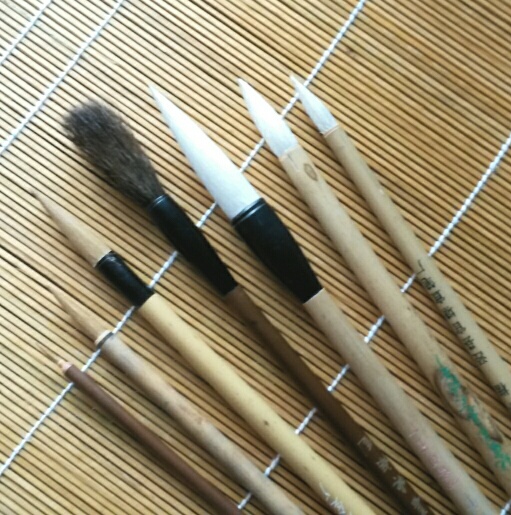 Get one generic brush for Chinese brush painting (Flower & Bird brush 花鳥筆), tip of brush about three-quarter to one inch in length, white or brown haired. (Cost from $5) Consider that it matters less how good your brushes are, more important is how often you practice painting.
To get a set of brushes to practice a variety of fine to broad brush strokes, choose one or two white haired brushes, small, medium, large White Cloud brush (小白雲, 中白雲, or 大白雲), cost $5-$8; and one brown haired brush, small, medium, large Bamboo & Orchid brush (小蘭竹, 中蘭竹, 大蘭竹), about $8-$20. The Bamboo & Orchid brown brush would be more expensive, so pick the size you are comfortable with, I recommend medium or large, some people like to paint large and some paint small, and you will use it for a while, I have mine all my life. And one or two fine brushes for outline painting, from $1-$5, as well as painting details such as veins of leaves, stamens of flowers, etc.
2. Ink – Chinese ink
 We use either Chinese ink or Japanese Sumi Drawing ink. The common brand for Chinese ink is called 一得閣墨汁, the Japanese ink is 墨液. The Sumi ink more highly concentrated, I like the Chinese ink for its consistency. Both can be used for painting and calligraphy.
As an alternative, artists in the past used an ink stick and ink stone to grind fresh made ink. Thus, the ink stone, ink stick, brushes, and paper, makes up the Four Treasures used in Chinese painting.
3. Paper
The paper I use during my brush painting workshops is Calligraphy Paper (60 sheets per pack @ $2.5) from a Japanese store. We can also practice with newsprint to get the flow but the absorbency of the newsprint is not the same as the xuan paper typically used in brush painting. I recommend using newspaper or pages from an old phone directory to practice the movement of the brush and varying strokes, but it will not do for learning control of the ink in terms of wet or dry brush.
Xuan paper (中國書畫宣紙) comes in a roll that can be cut into desirable sizes, it also comes in precut stacks depending on the supplier. The single xuan is relatively thin and very absorbent to Chinese ink. The xuan paper used in traditional Chinese painting comes in different weights/thickness. For painting refined portraits we use a coated (sized) xuan paper for which the coating makes the paper non-absorbent for the painter to take time in applying colors. For painting landscapes we often used a heavier, double xuan paper that can be half coated (half sized) or uncoated. For flower and birds we use uncoated (unsized) xuan paper.
 Painting with Pauline
Cool article about the supplies. Cool pictures! (of the brushes __)